SKIN / COLLAGEN AND DELIVERY
GHK-Cu Copper Peptide for Skin: Collagen, Elasticity and Delivery Research
What the copper-peptide skin literature actually measured — matrix synthesis, the procollagen comparison, serum concentrations and the dermal copper depot.
What the copper-peptide skin research shows
GHK-Cu copper peptide skin research is the best-documented part of the whole record. In human fibroblast cultures GHK-Cu raised collagen synthesis dose-dependently — onset between 10^-12 and 10^-11 M, peak near 10^-9 M, with no change in cell number [1]. The canonical skin-regeneration review extends that to a multi-modal matrix effect: synthesis of collagen, dermatan sulfate, chondroitin sulfate and the proteoglycan decorin, with placebo-controlled improvements in skin laxity, clarity, fine lines, wrinkle depth and density [3]. In that same review, topical GHK-Cu increased collagen production in 70% of treated women versus 50% for vitamin C and 40% for retinoic acid [3].
A 2023 study pushed the matrix angle further: combining GHK-Cu with low-molecular-weight hyaluronic acid at a 1:9 ratio elevated collagen IV synthesis 25.4-fold in human dermal fibroblast cultures and 2.03-fold in ex-vivo skin — a synergistic effect at the dermal-epidermal junction [7].
What Does GHK-Cu Do for Your Skin?
What does a copper peptide do for your skin?
In study models GHK-Cu stimulates synthesis of collagen, dermatan and chondroitin sulfate and the proteoglycan decorin; one review reports topical GHK-Cu raised procollagen in 70% of treated subjects versus 50% for vitamin C and 40% for retinoic acid [3]. Combined with low-molecular-weight hyaluronic acid it elevated collagen IV synthesis 25.4-fold in fibroblast culture and 2.03-fold in ex-vivo skin [7]. Mechanistically the peptide signals fibroblasts and rebalances MMPs against their TIMP inhibitors, while the copper supports lysyl-oxidase cross-linking [6].
Does GHK-Cu actually increase collagen production?
In human fibroblast cultures GHK-Cu increased collagen synthesis dose-dependently, with stimulation beginning between 10^-12 and 10^-11 M, peaking near 10^-9 M, and independent of any change in cell number [1]. The independence from proliferation indicates a specific metabolic effect — the cells make more collagen rather than there simply being more cells. The 2023 hyaluronic-acid synergy study reproduced a collagen-IV increase in both fibroblast and ex-vivo skin models [7].
How long does it take GHK-Cu to tighten skin?
There is no controlled timeline trial of pure GHK-Cu firming. Small placebo-controlled facial cream and serum studies (n approximately 20-71) reported measurable gains in skin density, firmness and fine lines over study courses of roughly two to three months [3]; texture changes are described earlier than firmness. No study has isolated a single tightening onset time for the pure complex.
The delivery problem and the dermal copper depot
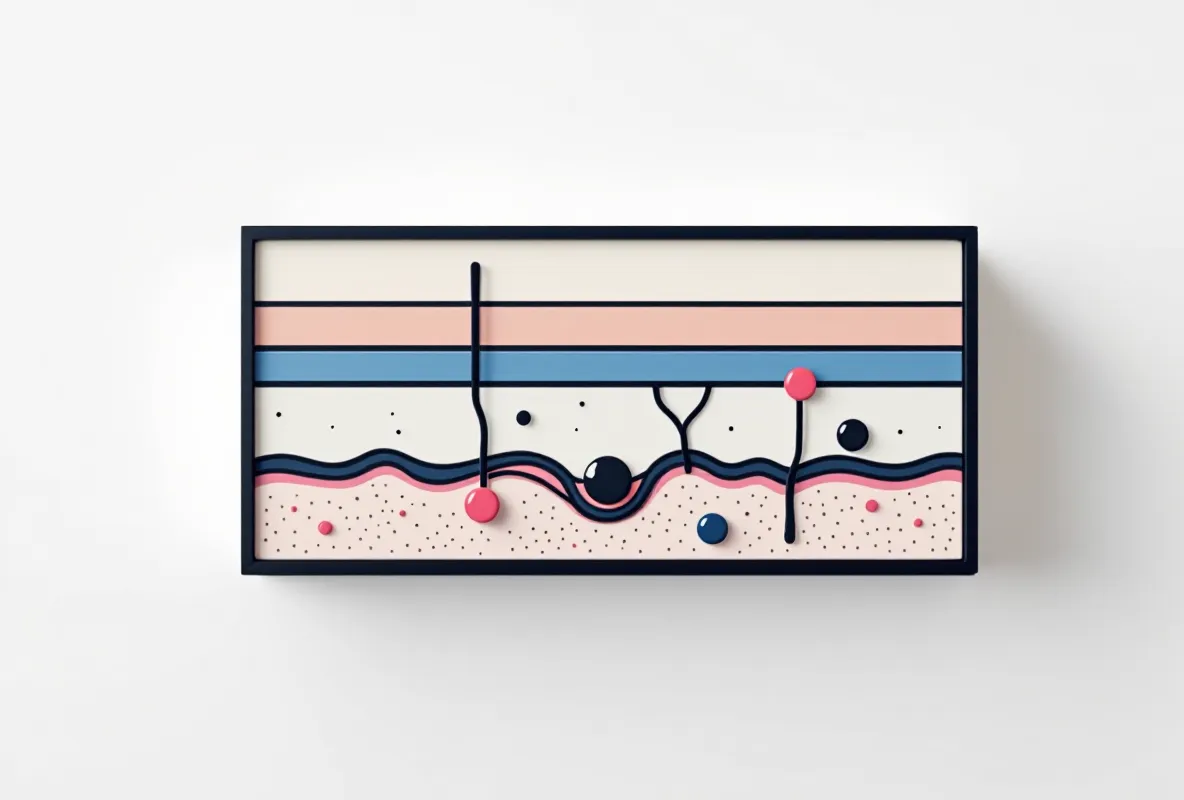
GHK-Cu's central formulation challenge is that the free peptide is highly hydrophilic (clogP -2.24), which limits passive stratum-corneum penetration [11]. Yet copper does cross when delivered as the complex. In a human skin penetration study, copper applied as the GHK-Cu tripeptide penetrated dermatomed skin with a permeability coefficient of 2.43 +/- 0.51 x 10^-4 cm/h; over 48 hours 136.2 +/- 17.5 ug/cm^2 of copper permeated and 97 +/- 6.6 ug/cm^2 was retained as a dermal depot [5]. That retained depot is the basis for the topical strategy — sustained local copper availability rather than rapid systemic exposure.
Enhancement strategies are an active research area. About 100 nm liposomal GHK-Cu carriers achieved 31.7% (anionic) and 20.0% (cationic) encapsulation efficiency, were stable for 4 weeks at room temperature, and produced 48.9% elastase inhibition in human epidermal cells with no cytotoxicity [8]. The 2025 review evaluates palmitoylation (Pal-GHK, clogP 1.14) and microneedle pretreatment, which let about 134 nmol GHK permeate versus none through intact skin [11].
Is GHK-Cu topical or injectable more effective for skin repair?
Published human and ex-vivo skin-repair data are almost entirely topical. A measured permeability coefficient and dermal copper depot establish a transdermal route [5]. No validated human pharmacokinetic data exist for injectable or systemic GHK-Cu [3], so the literature cannot rank injection against topical delivery for skin repair — the comparison has simply not been studied in humans.
Copper Peptide Serum Formulation in the Research Literature
Copper peptide serum formulation in the research literature centers on concentration, pH and encapsulation. Topical cosmetic and clinical formulations of GHK-Cu sit in the range of approximately 0.05% to 2% (w/w) across creams, serums and gels [3]. Stability is pH-dependent: the complex is most stable near pH 5-6.5 at a 1:1 copper-to-peptide ratio, and the blue-violet color of a reconstituted solution is the expected Cu(II) absorption signature of an intact complex, whereas brown or green shifts indicate oxidation or precipitation [3].
Encapsulation is the main stability and delivery lever in the published work. Liposomal GHK-Cu carriers of about 100 nm held for 4 weeks at room temperature and delivered 48.9% elastase inhibition in human epidermal cells without cytotoxicity [8]. These are formulation-science findings about how a serum can be built and kept stable in research models — not endorsements of any marketed product, and not a dosing instruction.
What shouldn't be mixed with GHK-Cu?
Strong reducing agents such as ascorbic acid (vitamin C) below about pH 3.5 reduce Cu(II) and break the complex [3]; AHAs, BHAs and other low-pH actives can also destabilize it or compete for copper. The complex is most stable near pH 5-6.5 [3]. Mixing GHK-Cu with a low-pH vitamin-C serum can therefore degrade both actives at once — a documented formulation and user-error risk.